A CD ladder splits one pot of cash across several certificates of deposit with staggered maturity dates, so a slice of your money comes free every year instead of all of it being locked up for five. You get most of the yield of a long CD with something close to the access of a short one. In August 2026, with the Federal Reserve frozen at a 3.50% to 3.75% target range and openly split on what comes next, a CD ladder is the rare savings strategy that does not require you to guess the direction of rates.
Every guide to building a CD ladder written in the past two years starts the same way: lock in now, before rates fall. That advice made sense in late 2025, when the Fed cut three times in a row. It does not describe the market you are actually saving into today.
On July 29, 2026, the Federal Open Market Committee held the federal funds target at 3.50% to 3.75% for the fifth consecutive meeting this year. The vote was 9 to 3, and the three dissenters, Beth Hammack, Neel Kashkari and Lorie Logan, all wanted to raise rates by a quarter point. Not cut. Raise. When the people who set the rate cannot agree on which way it should move, a saver reading tea leaves is wasting their afternoon.
That is precisely the situation a ladder is built for. It does not win big in any single scenario. It does something more useful: it stops you from being badly wrong in any of them.
- A CD ladder staggers maturity dates so one rung comes due each year, which turns a five year commitment into an annual decision.
- The gap between the average CD and the best CD is enormous right now: 1.72% national average on a one year term versus 4.25% at the top of the market.
- Top short CDs currently pay about the same as top high yield savings accounts, so laddering in 2026 buys certainty, not extra yield on day one.
- A worked $10,000 ladder earns roughly $431 in year one and about $1,375 across the full five year cycle at today’s rates.
- Skip the ladder entirely for your emergency fund or for money you might need inside twelve months.
- What a CD ladder actually is
- Why a CD ladder makes sense in a frozen rate market
- How to build a CD ladder, step by step
- A worked $10,000 CD ladder example
- CD ladder versus high yield savings versus Treasury bills
- Ladder, barbell or bullet
- What to do when a rung matures
- Mistakes that quietly drain a ladder
- When a CD ladder is the wrong tool
- Frequently asked questions
What a CD ladder actually is
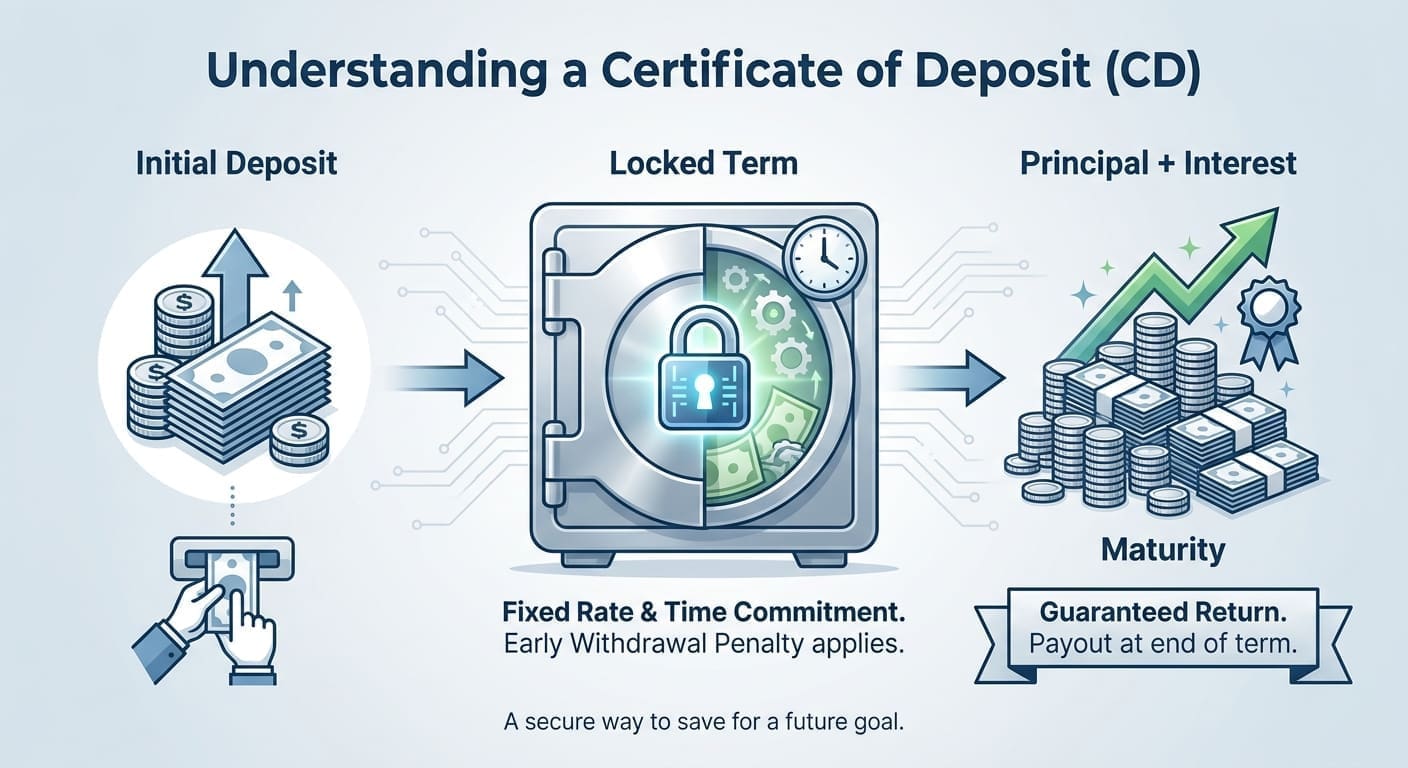
A certificate of deposit is a deposit account with a fixed rate and a fixed end date. You hand a bank money, the bank guarantees an annual percentage yield for the term, and you agree not to touch the balance until it matures. Break that agreement and you pay an early withdrawal penalty. If the mechanics are new to you, our explainer on what a certificate of deposit is and how the rules work covers the basics in more detail.
The single CD problem is obvious. A five year term pays the most, but five years is a long time to be wrong about your own life. A three month term keeps you liquid, but you are back at the same decision four times a year with no protection if rates slide.
A CD ladder resolves that tension by refusing to choose. Instead of one $10,000 certificate, you open five certificates of $2,000 each, maturing one year apart. Twelve months later, the one year rung comes due. You either take the cash or roll it into a new five year CD at whatever the market pays then. Do that every year and, after the first cycle, you permanently hold five year CDs while still getting 20% of your money back annually.

That is the whole idea. The rungs are the individual CDs, the spacing is the gap between maturity dates, and the discipline is rolling each matured rung back out to the long end. Everything else in this guide is a detail hanging off that structure.
Why a CD ladder makes sense in a frozen rate market
Here is the data that should shape your decision, rather than a forecast nobody can defend.
Federal funds target, unchanged for five straight meetings this year.
July vote, with all three dissenters pushing for a hike rather than a cut.
National average one year CD against the best one year CD on the market.
Look at that third number for a moment, because it matters more than anything the Fed does. The national average one year CD pays 1.72%. The best one year CD pays 4.25%. On $10,000, that is the difference between $172 and $425 a year for identical federally insured risk. Most people lose more money to inertia at their existing bank than they will ever lose to bad rate timing.
Now the uncomfortable part, which most CD ladder articles skip. The best high yield savings accounts currently pay around 4.20% to 4.34%, with a couple of promotional accounts reaching higher on small balances. The best one year CD pays 4.25%. In other words, locking your money up for a year currently buys you almost no extra yield at all.
Because a savings APY is a variable rate that a bank can cut on a Tuesday morning without asking you, and a CD rate is a contract. You are not paying for a bigger number today. You are paying for the right to keep today’s number in 2028. If the Fed does eventually cut, savings yields follow within weeks. Your three, four and five year rungs will not move at all.
That asymmetry is the real argument. If rates rise, your annual rung rolls into the higher market and you capture part of the move. If rates fall, four fifths of your money is already locked above where new money is being paid. Neither outcome makes you a genius. Both outcomes leave you fine, which is the point of a savings strategy. We tracked the slow drift in deposit yields in our look at what is happening to savings account rates this year.
How to build a CD ladder, step by step
Before a single dollar goes into a CD, your emergency fund belongs somewhere you can reach in a day. Size it first with our emergency fund calculator, park it in a liquid account, and only ladder what is left over.
Five rungs one year apart is the classic. If you want cash free more often, run six rungs six months apart across three years. Longer ladders lock in more, shorter ladders adapt faster.
Equal rungs keep the maths simple and the maturities predictable. Watch the minimum deposits, because some of the best rates require $1,500 or even $10,000 per certificate, which quietly rules them out of a small ladder.
There is no rule saying every rung lives at the same bank, and no bank leads on every term. Opening five accounts at five institutions is tedious once and worth hundreds of dollars. Check how each one calculates annual percentage yield and confirm it is federally insured.
Note the early withdrawal penalty, the grace period after maturity, and whether the CD auto renews. Auto renewal at a bank’s default rate is how a carefully built ladder ends up earning 0.60%.
Set a reminder ten days before each one. The grace period is usually seven to ten days, and missing it is the single most common way ladders fail.
A worked $10,000 CD ladder example
The table below uses representative top of market APYs available in early August 2026, with $2,000 in each rung. Interest is shown for the full term of each certificate, compounded annually.
| Rung | Amount | APY | Interest at maturity | Value at maturity |
|---|---|---|---|---|
| 1 year | $2,000 | 4.25% | $85.00 | $2,085.00 |
| 2 year | $2,000 | 4.30% | $175.70 | $2,175.70 |
| 3 year | $2,000 | 4.35% | $272.52 | $2,272.52 |
| 4 year | $2,000 | 4.30% | $366.83 | $2,366.83 |
| 5 year | $2,000 | 4.35% | $474.53 | $2,474.53 |
| Total | $10,000 | 4.31% blended | $1,374.58 | $11,374.58 |
Two numbers are worth pulling out of that table. The blended yield across the whole ladder is 4.31%, which means the first twelve months generate $431 in interest across the five rungs. And the same $10,000 sitting in national average CDs at 1.72% would generate $172. Choosing the right banks is worth $259 a year before you have made a single call on interest rates. You can run your own amounts through our CD calculator or model the compounding over longer horizons with the compound interest calculator.
One honest caveat on the total. That $1,374.58 assumes you hold each rung to its own maturity and do nothing else. In practice you will roll the shorter rungs into new five year CDs, so your real lifetime return depends on rates in 2027, 2028 and beyond, which is exactly the thing the ladder exists to stop you from guessing.

CD ladder versus high yield savings versus Treasury bills
A CD ladder is not automatically better than the alternatives. It is better at a specific job. Here is the honest comparison.
| CD ladder | High yield savings | Treasury bills | |
|---|---|---|---|
| Rate certainty | Fixed for each term | Variable, can change any day | Fixed to maturity |
| Access to cash | One rung per year, penalty otherwise | Same day, no penalty | Sell on the secondary market at market price |
| Protection | FDIC or NCUA insured to $250,000 | FDIC or NCUA insured to $250,000 | Backed by the US Treasury |
| State income tax | Taxable | Taxable | Exempt from state and local tax |
| Best for | Money with a known timeline | Emergency funds and flexible cash | High tax bracket savers in high tax states |
For most people the answer is not one or the other. It is a liquid savings account holding three to six months of expenses, and a ladder holding the money earmarked for a house deposit in three years or a car in two. If you are still choosing where the liquid half lives, our guide to picking a high yield savings account walks through the fee traps, and we compared the biggest online options in online banks like Ally and SoFi versus Ally.
Ladder, barbell or bullet
The ladder is one of three shapes you can give a set of CDs, and the other two are worth knowing because they suit different goals.

Equal amounts spread evenly across terms. The default choice when you want steady access and no strong view on rates.
Money concentrated at the very short and very long ends, with nothing in the middle. It suits a saver who wants meaningful liquidity soon and meaningful lock in later, and who thinks the middle of the curve is poorly paid. Given how flat CD pricing is in 2026, the barbell is harder to justify than usual.
Several CDs bought at different times but all maturing on the same date. This is the right shape when you have one fixed target, such as a down payment you know you need in September of a particular year.
What to do when a rung matures
This is where ladders are won and lost, and in a frozen rate market the decision is genuinely less obvious than the textbook says.
The textbook answer is to roll every matured rung into a new CD at the longest term in your ladder, which keeps the structure intact and pushes your average yield toward the long end. That is still the right default. But run one check before you do it: compare the new long term CD rate against the best liquid savings rate you can get that day. In August 2026 the two are within a fraction of a point of each other, which means the extra yield you are being paid to lock up five years of money is close to zero.
If the best five year CD pays at least half a point more than the best savings account, roll the rung out to five years without hesitating. If the premium is under a quarter point, shorten that rung to one or two years and revisit next time. You keep the ladder alive either way, and you stop paying for a lock that is not being priced.
Whatever you decide, act inside the grace period. Most banks give you seven to ten days after maturity, and if you say nothing the certificate rolls over automatically at whatever the bank feels like paying, which is rarely the rate that made you open it.
Mistakes that quietly drain a CD ladder
The default renewal rate at a big bank can be under 1%. One missed grace period can cost more than three years of careful rate shopping earned you.
Penalties run to roughly six months of interest on one to three year terms and twelve months on four and five year terms. Some banks charge up to fifteen months. Read the number before you deposit, not after.
Interest credited to a multi year CD is taxable as ordinary income in the year it is credited, and the bank issues a 1099-INT for it, even though you cannot touch the money yet. Budget for that gap.
Coverage from the FDIC stops at $250,000 per depositor, per insured bank, per ownership category. A large ladder should spread rungs across institutions for coverage as well as for yield.
Plenty of savings products are offered by companies that are not themselves banks, with insurance passed through to a partner. It usually works, but the mechanics matter. We covered what that means in are neobanks safe and what happens if a neobank shuts down.
When a CD ladder is the wrong tool
A ladder is a commitment device, and commitment devices are harmful when applied to the wrong money. Do not build one if any of the following is true.
Your emergency fund is not fully funded yet. Cash you might need inside twelve months should stay liquid, full stop. Your time horizon is longer than a decade and you are actually saving for retirement, in which case a diversified portfolio has beaten CDs over almost every long stretch of history. Your balance is small enough that the difference between 4.30% and 4.15% is a couple of dollars and the admin is not worth your evening. Or you know yourself well enough to admit you would break the CD the first time something interesting came along, in which case the penalty makes the whole exercise negative.
There is also a simpler test. If you cannot name the thing the money is for and roughly when you need it, you are not ready to pick term lengths. Sort the goal out first with the savings calculator, then come back and build the ladder around it.
Frequently asked questions
Technically as little as $500, since plenty of online banks have no minimum or a $500 floor. Practically, the best rates often require $1,500 or $10,000 per certificate, so a ladder of $5,000 or more gives you a genuine choice of banks rather than whatever will accept small deposits.
Not for liquidity, and right now not for headline yield either, since top savings accounts and top short CDs pay within a fraction of a point of each other. A CD ladder wins on certainty: the rate is contractual for the whole term, while a savings APY can be cut at any time.
You can withdraw early, but you pay a penalty, usually around six months of interest on shorter terms and up to twelve or fifteen months on longer ones. On a young CD that penalty can exceed the interest earned, so you get back less than you deposited.
That is one of the better reasons to ladder rather than buy a single long CD. If rates rise, your nearest rung matures within a year and rolls into the higher market, so only part of your money is stranded at the old rate.
Yes. Interest credited to the account is taxable as ordinary income for the year it is credited and reported on a 1099-INT, even on a multi year CD you have not touched. The exception is a CD held inside a tax advantaged retirement account.
You can, and it is far easier to manage. It just costs you yield, because no single institution leads the market at every term. Splitting a ladder across three or four banks is the usual compromise between admin and return.
The bottom line
A CD ladder is not a clever trade. It is an admission that you cannot forecast interest rates, dressed up as a structure. In a year when the Federal Reserve has sat still through five straight meetings and three of its own voters want to move in the opposite direction to everyone else, that admission looks less like caution and more like realism.
Build the ladder on money with a name and a date attached. Shop every rung, because the 2.5 point gap between the average CD and the best one dwarfs anything the Fed is likely to do this year. Diarise the maturity dates. Then go and think about something else, which is the actual return on a well built ladder.
Run your own numbers before you open anything. Our free CD calculator shows what each rung earns at a given term and APY, and the full set of free financial calculators covers savings goals, compound growth and emergency fund sizing. If you want to understand how we assess the banks we mention, read how we rate banks and apps.
Further reading: what a CD is, how APY works, whether Cash App savings is really high yield, digital versus traditional banks, and the complete guide to digital banking.
Rates and terms cited were verified against Bankrate, NerdWallet and the Federal Reserve at the time of writing and change frequently. Confirm current APYs, minimums and penalties directly with the institution before opening any account. This article is information, not personalised financial advice. Federal Reserve policy details come from the FOMC calendar and statements.