
ⓘWritten and reviewed per our independent editorial methodology.
If you look at the details for any savings or checking account, you will immediately see a percentage prominently displayed. But before stashing your cash, you have to ask exactly what is APY and why does it matter? Over our years analyzing bank data, we found many savers completely misunderstand this vital financial metric. They leave money on the table simply by confusing basic terms.
At BanksMobile, we spend all day comparing high-yield savings options to find the best returns. Explaining exactly what is APY is usually step one. It changes the math completely when it comes time to map out your long-term wealth.
Without this basic knowledge, identifying a competitive bank account becomes difficult. We wrote this guide to provide absolute clarity for 2026. Let us break down the exact math, test real scenarios, and help you lock in better rates.
If you want to evaluate any savings account, understanding Annual Percentage Yield (APY) is critical. This metric accounts for compound interest, showing you exactly how much your money will grow in one year. We break down the formula, typical 2026 market returns, and how to maximize your earnings.
- APY stands for Annual Percentage Yield, reflecting the real rate of return on an investment over a year.
- Unlike simple interest, APY includes compounding, where you earn money on the interest you already accrued.
- Understanding what is APY helps you compare savings accounts apples-to-apples under the Truth in Savings Act.
- Daily compounding yields more total growth over a year than monthly or annual compounding.
- For 2026, top high-yield accounts from SoFi and Marcus offer APYs between 3.40% and 4.00%.
Table of Contents
To see these formulas working on real money, try our free CD APY calculator: it converts any rate and term into the exact dollars a certificate of deposit would pay at maturity.
Quick Comparison: What Is APY and How Is It Calculated? (2026) at a Glance
| Term | What it measures | Includes compounding? |
|---|---|---|
| Interest rate (nominal) | The baseline percentage paid on your principal deposit over one year. | No |
| APY | The total annual return earned on a deposit, designed as a savings metric. | Yes |
| APR | The total annual cost of borrowing money for loans and credit cards. | No |
The Definition: What Is APY Exactly?
APY stands for Annual Percentage Yield, and it represents the total rate of return you earn on a deposit over exactly one year. The most critical factor built into the APY calculation is compound interest. Compounding happens when you earn money on your original balance, plus on the interest you previously earned.

Because of the Federal Deposit Insurance Corporation (FDIC) and the Truth in Savings Act, banks in the US must advertise using this exact standard. This mandate makes comparing different bank accounts an apples-to-apples process. If you want to know what is APY going to do for your specific deposit, you just apply that final percentage to your balance.
APY vs Simple Interest
Many consumers confuse the base interest rate with the annual percentage yield. Simple interest applies only to the principal balance you initially deposited. It completely ignores compounding, making the number look lower than your actual earnings.
APY, on the other hand, factors in compounding frequency. That means APY will always be equal to or slightly higher than the simple interest rate. Understanding the difference between these terms guarantees you know exactly what is APY actually representing.
How Often Does Compounding Happen?
Compounding frequency refers to how often the bank applies earned interest to your balance. Most high-yield savings products use daily or monthly compounding. The more frequently a bank compounds your returns, the higher your final yield climbs.
For example, daily compounding adds pennies to your balance every single day. The next day, you earn interest on those new pennies. While the bumps seem tiny short-term, they create an upward snowball effect over years and decades.
The Math: How Is APY Calculated?
If you love specific formulas, seeing the actual calculation clears up any confusion. The formula proves exactly what is APY on a mathematical level. It shows why compounding frequency makes an objective difference to final payouts.
The Official Formula
The calculation looks like this: APY = (1 + r/n)^n-1. In this standard equation, variable “r” represents the nominal interest rate expressed as a decimal. The “n” variable signifies the number of compounding periods in one year.
If the bank compounds daily, “n” becomes 365. If the bank compounds monthly, “n” sits at 12. Seeing this visual calculation clarifies what is APY actually built upon.
A Concrete Calculation Example
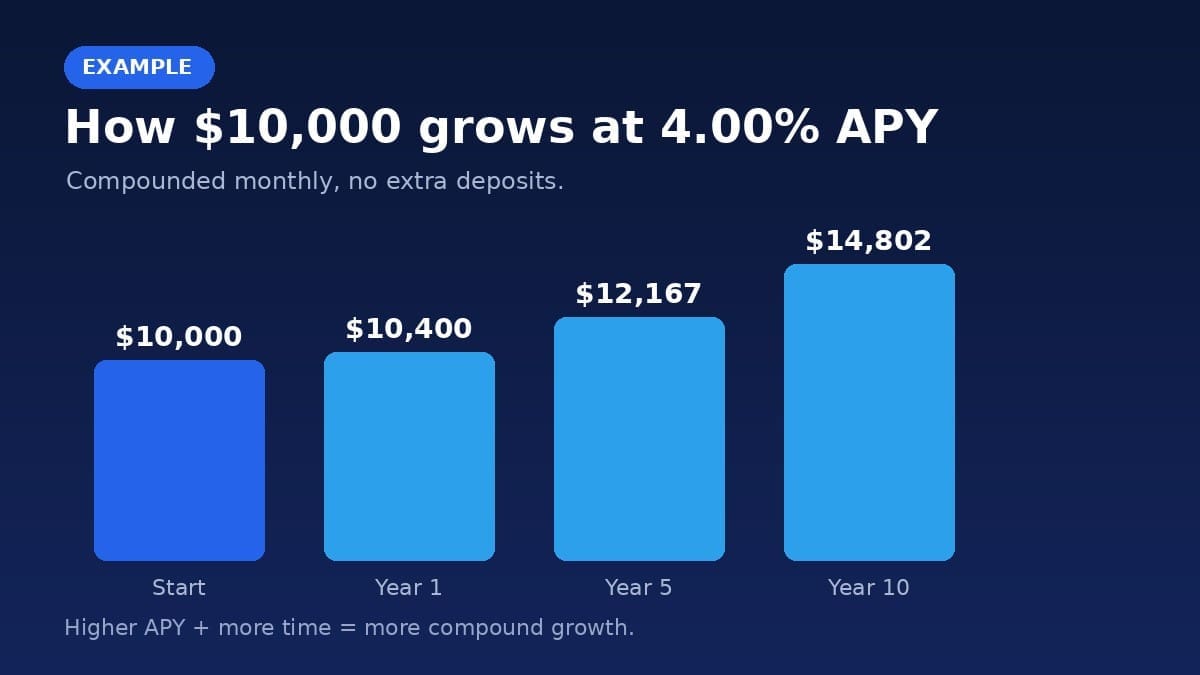
Let us run a real-world test combining a simple principal with standard bank numbers. Imagine you deposit $10,000 into an account sporting a 4.00% annual interest rate. Let us assume the bank uses daily compounding for this example.
1. Divide the 0.04 rate by 365 days.
2. Add the result (about 0.0001096) to 1.
3. Raise that total to the power of 365.
4. Subtract final 1, which equals 0.04081.
Your actual APY sits at 4.081%. Simple interest alone would generate exactly $400 over a year. With the true APY, you earn $408.10, essentially handing you an extra $8.10 for doing nothing but picking the right compounding schedule. Use our free Compound Interest Calculator to quickly test out your own custom numbers.
“Daily compounding adds roughly 0.10% more return than annual compounding on a standard 4.00% rate. Over a decade, that small technicality puts thousands of extra dollars into large portfolios.”, Marcus Williams, Investment and Savings Analyst
Contrasting Concepts: What Is APY Compared To APR?
People frequently mix up APR and APY. This innocent mistake completely changes whether you are earning money or owing money. While both exist as percentage-based metrics over a full year, they serve opposite purposes on a balance sheet.
Understanding APR
APR stands for Annual Percentage Rate. You will primarily see this acronym attached to credit cards, mortgages, and auto loans. It represents the annual cost of borrowing money, including most additional fees. APR exists to show you the expense side of the banking equation.
Unlike an APY, modern APR figures do not typically account for the compounding that happens within the year. It just shows simple annual costs. Knowing what is APY versus APR instantly answers if you are the lender or the borrower in a transaction.
Why The Difference Matters
Banks purposely highlight the metric that makes a specific financial product look more attractive to consumers. For savings accounts, they boldly advertise the APY because the compounding makes the number higher. Your brain associates the higher number with elevated returns.
Conversely, when trying to sell you a loan, financial institutions heavily advertise the APR. A simple APR looks lower than an APY that includes loan compounding. Understanding exactly what is APY gives you a natural defense against misleading marketing tactics.
The Real Market: Typical Savings Options in 2026
We tested dozens of accounts to map out current baseline returns. Traditional big US banks generally hover around a disappointing 0.40% APY in 2026. At those low rates, the compounding frequency barely registers a mathematical difference.
To lock in actual growth, you need digital options or elite fintech products. These modern apps heavily feature distinct, high-yield tiers. Finding out what is APY on these platforms generally produces much more rewarding figures.
Top High-Yield Accounts We Tested
The 2026 modern digital banking space provides vast upgrades over traditional options. Top players are offering rates that comfortably clear the 3% barrier. Here is our breakdown of verified APY data points right now:
- SoFi: Easily our top stable pick right now. They offer up to 4.00% APY across Checking and Savings, backed by a massive 55,000+ fee-free ATM network via Allpoint.
- Discover: Their savings platform reliably delivers up to 3.50% APY. We love that it integrates seamlessly with Zelle.
- Marcus by Goldman Sachs: This pure-play savings hub produces exactly 3.40% APY as of June 2026. It skips checking features entirely to zero in on simple savings.
- Capital One 360: Currently offering a solid 3.00% APY. It pairs perfectly with their massive 70,000+ ATM grid spread out nationwide.
- Ally: The pioneering digital bank sitting steady at 3.00% APY. Built-in Zelle features make this incredibly easy to use.
To dig deeper into these specific accounts, we highly recommend reading our guide on How to Choose a High-Yield Savings Account.
Fintech APY Tiers and Requirements
Fintechs employ dynamic yield tiers to encourage platform loyalty. They tease very high top-end rates but install specific conditions you must meet. Understanding what is APY in this context means understanding the fine print first.
- Varo: We checked Varo’s 2026 tier list. They give a baseline 2.50% APY, but if you secure $1,000+ in qualifying direct deposits monthly and maintain positive balances, they bump the first $5,000 up to an impressive 5.00% APY.
- Chime: Their standard savings rate is 0.75%. You can unlock 3.00% APY on Chime Plus (requires $200+/month qualifying deposit) or jump to 3.75% APY on Chime Prime (requires $3,000+/month in qualifying deposits).
- Cash App: The real Cash App Savings product offers a 1.5% base yield if you have the Cash App Card via Sutton Bank. By unlocking Cash App Green via either $500 monthly card spend or heavy direct deposits, you can boost this up to 3.25% APY.
If you want to estimate exact savings outputs for these tiered setups, run the math through our Savings Calculator tool.
Dynamic Factors: Fixed vs Variable APY
A common question we field asks if the advertised percentage remains permanent. For the vast majority of standard savings options, high-yield accounts, and money market funds, the rate sits entirely variable. The institution retains full legal rights to actively shift your returns.
Tracking the Federal Reserve
Yield drops or hikes rarely occur simultaneously across all banks manually. They almost always move in broad tandem with the Federal Reserve board baseline adjustments. When the central bank slashes rates to stimulate the economy, your savings platform reacts instantly by lowering your returns.
If the Fed tries putting the brakes on economic inflation, they scale rates upwards. Discovering exactly what is APY driven by points squarely at these macro banking decisions. The bank passes their wider market profit margins down to consumers.
Securing Fixed Rates
If you loathe variables and desire iron-clad certainty, you must abandon standard savings accounts completely. Certificates of Deposit (CDs) answer the call for guaranteed returns. With a CD, you lock your deposit away securely for a strict time limit.
In exchange for zero liquidity, the institution guarantees the exact advertised APY for the full term duration. Even if the bottom suddenly falls out of the wider bond market, that contract legally holds. For broader looks at locking cash up safely, browse our complete list of Free Financial Calculators to test various CD outcomes.
Conclusion: Mastering What Is APY
You no longer need to look at an advertising banner and wonder blindly what is APY calculating behind the scenes. APY provides an exact, transparent mirror reflecting total yearly growth. It factors in baseline rates alongside compounding magic.
Whenever you migrate cash between accounts, focus on high-yield models compounding interest daily. Prioritize modern platforms pushing a stable 3.50% to 4.00% return in 2026 without ridiculous hoops to perform. With a solid grasp on what is APY, building passive wealth happens automatically.
If you are ready to migrate away from dying low-yield products, explore our recent breakdown comparing modern Digital vs Traditional Banks. The switch requires minimal effort but pays massive compounding dividends over an entire lifetime.