Written and reviewed per our independent editorial methodology. Advertiser disclosure: BanksMobile may earn compensation from some partner links on this page. This never influences our ratings, which follow our rating methodology. Read our disclaimer.
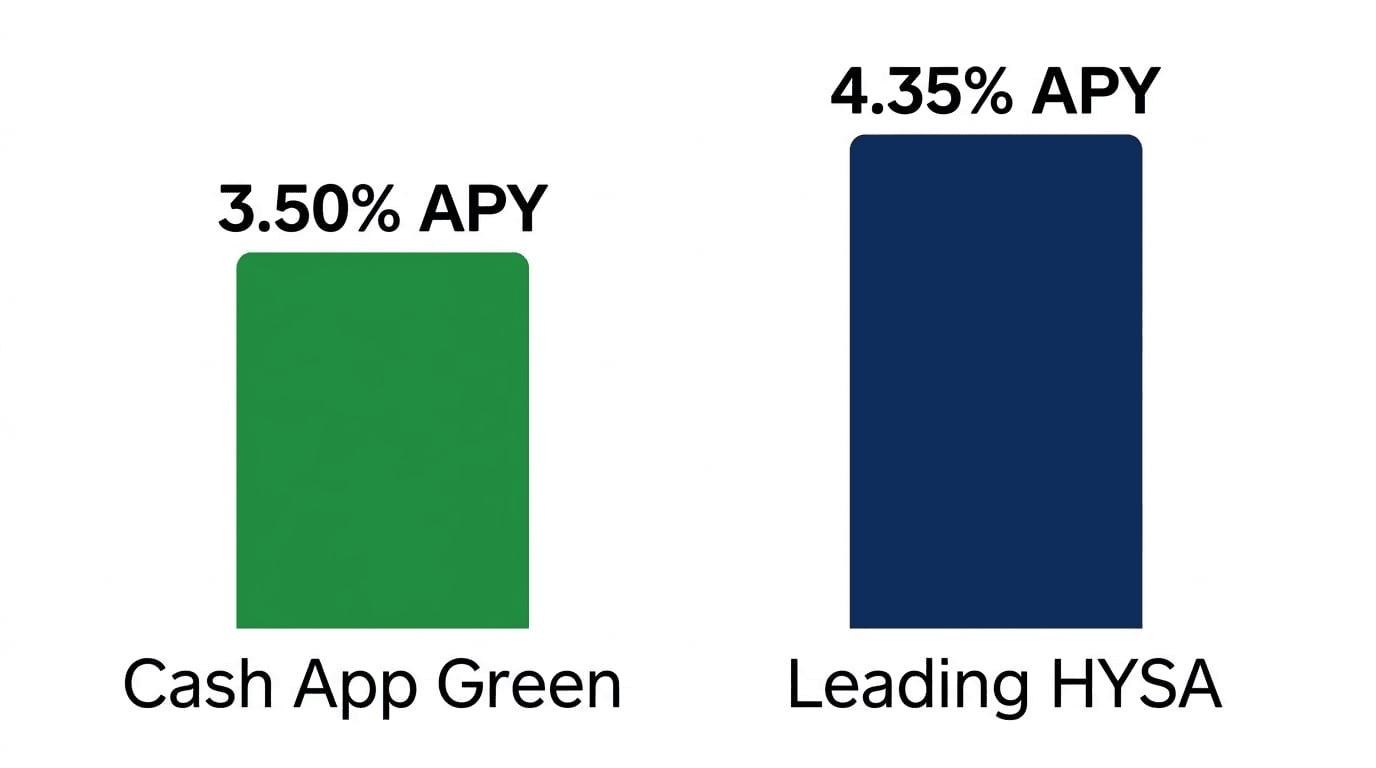
Cash App Savings can be considered high-yield only at its top tier, which offers a 3.50% APY as of October 5, 2026. However, this rate is conditional and lower than the leading online savings accounts, which offer up to 4.35% APY. The base rate for Cash App Savings is a much lower 1.50% APY.
So, is Cash App savings high yield? The direct answer is: conditionally. While its top rate of 3.50% APY is competitive, it falls short of the highest-yield accounts available and requires meeting specific criteria. Without meeting those conditions, the rate drops to a non-competitive 1.50% APY.
This dual-rate structure is the core of the Cash App Savings product. To earn the higher yield, you must qualify for Cash App Green status, which involves minimum monthly spending or direct deposits.
This makes it a compelling option for existing, active Cash App users but a potentially less attractive primary savings vehicle for others.
This analysis breaks down the numbers behind both APY tiers, verified on October 5, 2026. We will compare Cash App’s best offer against the leading online savings accounts, examine the fine print on balance caps and FDIC insurance, and provide a data-driven verdict on whether it truly qualifies as a top-tier high-yield option.
- ✓Cash App Savings offers two APY tiers: 1.50% for users with a Cash App Card and a boosted 3.50% for users who qualify for Cash App Green.
- ✓The 3.50% APY is not automatic; it requires at least $300 in monthly qualifying deposits or $500 in monthly card spending.
- ✓Compared to the market, Cash App’s top rate is lower than the leading online savings accounts, which offer APYs as high as 4.35%.
- ✓Funds in Cash App Savings are held at Wells Fargo Bank, N.A. and are eligible for pass-through FDIC insurance up to $250,000, subject to aggregation rules.
Table of Contents
What Are the Two APY Tiers for Cash App Savings?
Cash App Savings operates on a tiered interest rate system. The rate you earn depends entirely on your account status and activity within the Cash App ecosystem. It’s not a single, universal rate for all savers.
The standard rate is 1.50% APY. To earn this rate, you simply need to have an active Cash App Card linked to your personal account. Business accounts are not eligible for savings interest.
The higher, promoted rate is 3.50% APY. This is the rate that positions Cash App as a high-yield contender. However, earning it requires you to achieve ‘Cash App Green’ status, which has specific monthly requirements.
These rates were verified directly from Cash App’s official site on October 5, 2026. It’s crucial to understand that these are variable rates. Cash App can change them at any time, which is standard practice for savings accounts.
For context, the national average savings rate, according to the FDIC, often hovers well below 1.00%. So, even the base 1.50% APY exceeds that benchmark, though it pales in comparison to dedicated high-yield savings accounts from online banks.
How Do You Qualify for the 3.50% APY with Cash App Green?
Unlocking the 3.50% APY is not passive. It requires active and consistent use of Cash App’s services to qualify for Cash App Green status. You must meet one of two conditions each month.
Here’s the deal: The requirements are designed to make Cash App a central part of your financial life. They are not difficult for an active user but represent a hurdle for someone just looking for a place to park their savings.
The first path to qualification is through direct deposits. You must receive at least $300 in qualifying deposits into your Cash App account each month. This includes eligible payroll, pension, or government-benefit deposits.
The second path is through spending. You can qualify by spending at least $500 in a month using your Cash App Card or Cash App Pay. This demonstrates active engagement with their payment products.
Failing to meet either of these requirements in a given month means your savings rate will revert to the standard 1.50% APY. The boost is not permanent; it’s earned on a monthly basis.

Is Cash App Savings High Yield Compared to Top Online Banks?
This is the most important question for a data-first analyst. When placed side-by-side with the market leaders, Cash App’s top rate is competitive, but it is not the best available.
As of October 2026, leading online banks listed on NerdWallet offer APYs as high as 4.35%. This is a significant 0.85 percentage points higher than Cash App’s 3.50% Green rate. On a $10,000 balance, that’s a difference of $85 in earnings over a year.
Let’s look at a concrete example. A $25,000 balance in a leading HYSA at 4.35% APY would earn approximately $1,087.50 in one year. The same balance in Cash App Savings at 3.50% APY would earn $875.
That $212.50 difference is the cost of choosing Cash App over a top-tier provider, assuming you even qualify for the Green rate.
Other major financial publications show similar findings. Bankrate’s top listed rate was 4.25% APY, and a Forbes listing showed an account at 3.90% APY. In every comparison, Cash App’s best rate is beaten by dedicated online savings providers.
The conclusion is clear. If your absolute top priority is maximizing the return on your savings with no strings attached, other platforms offer a mathematically superior option. Cash App’s value proposition is convenience for existing users, not peak APY.
What Are the Catches and Conditions of Cash App Savings?
The headline 3.50% APY comes with several important caveats that every potential saver must understand. The most significant is the conditionality we’ve discussed. It’s not a ‘set it and forget it’ account if you want the best rate.
The base rate of 1.50% APY is a major catch. If you fail to meet the Green qualifications for a month, or if you only use Cash App sporadically, your returns will be substantially lower than what you could get from almost any other high-yield account.
Furthermore, the rate is variable. Cash App’s legal disclosures, available at cash.app/legal, state that the rate can change at any time. While this is true for all savings accounts, it’s important to monitor, as a rate cut could diminish its appeal.
Finally, while Cash App advertises no maximum balance cap on its main savings page, it’s always wise to check the full terms for any tiered language. Some accounts pay a high APY only up to a certain balance. The cap, or lack thereof, matters more than the rate for large depositors.
Understanding the full picture of what APY means, including its conditions, is critical before committing funds.

How Does FDIC Insurance Work with Cash App Savings?
A critical question for any saver is whether their money is safe. Cash App is a financial technology company, not a bank. Therefore, it does not provide FDIC insurance itself.
Instead, it partners with an FDIC-member bank to hold customer funds. For Cash App Savings, the partner bank is Wells Fargo Bank, N.A., Member FDIC. This is a crucial detail for account safety.
Your funds in a Cash App Savings account are eligible for what is known as ‘pass-through’ FDIC insurance. This means that if Wells Fargo were to fail, your deposits would be protected by the FDIC up to the standard maximum of $250,000.
Here is the key point: This $250,000 limit is per depositor, per insured bank, for each account ownership category. If you already have other personal deposits at Wells Fargo, those will be aggregated with your Cash App savings balance when calculating your total coverage at that specific bank.
This structure is common among neobanks and fintech apps. While generally safe and reliable, it’s an important distinction from holding an account directly at a bank. You can learn more about how FDIC insurance works at the official FDIC website.
For more on neobank safety, see our guide on are neobanks safe.
Cash App is not a bank. Your savings are held at Wells Fargo Bank, N.A. FDIC insurance ‘passes through’ Cash App to you, but your total deposits at Wells Fargo (including any you hold there directly) are combined for the $250,000 insurance limit.
Are There Balance Limits or Fees on Cash App Savings?
From a fee perspective, Cash App Savings is very straightforward. According to their official savings page, there are no monthly fees associated with the account. This is a significant plus, as fees can quickly erode interest earnings.
The platform also advertises no minimum balance to open an account or to earn interest. You can start saving with any amount, and the stated APY will apply to your entire balance, whether it’s $5 or $50,000.
Regarding a maximum balance, Cash App does not publicly state a cap for the savings balance to which the APY applies. This is an advantage over some competitors that may cap the balance eligible for the highest rate tier.
However, it is always best practice for depositors with very large sums to verify the latest terms of service directly. A high APY with no balance cap is the ideal scenario for maximizing returns.
Transfers and withdrawals are also a strong point. Cash App describes savings transfers as unlimited, which offers excellent flexibility compared to traditional savings accounts that used to be limited to six withdrawals per month under the old Regulation D.
The Verdict: Who Should Use Cash App Savings?
After analyzing the rates, conditions, and competition, the ideal user for Cash App Savings becomes clear. It is not the universal best choice for every saver in the market.
The bottom line: Cash App Savings is best for individuals who are already deeply integrated into the Cash App ecosystem. If you already use Cash App for direct deposits and daily spending with the Cash App Card, qualifying for the 3.50% APY is almost effortless.
For these users, the convenience of having their spending and saving accounts in one app, combined with a competitive (if not chart-topping) APY, is a powerful combination. It simplifies personal finance management significantly.
However, if you are a pure ‘rate chaser’ whose sole goal is to get the highest possible return on your cash with minimal effort, you should look elsewhere. Dedicated online banks offer higher APYs without any monthly spending or deposit requirements.
Ultimately, the question ‘is Cash App savings high yield’ depends on your user profile. For the active Cash App power user, the answer is yes, it functions as a high-yield account. For everyone else, it is a good account, but not the highest-yield option available.
Frequently Asked Questions
Is Cash App savings high yield in 2026?
At its top tier, yes, but with conditions. Cash App offers a 3.50% APY if you qualify for Cash App Green status. This is competitive but lower than the best online savings accounts, which reach 4.35% APY. The base rate is only 1.50% APY.
How often does Cash App pay interest on savings?
Cash App’s terms state it passes through a portion of the interest paid on the savings balance held at its partner bank. While the exact crediting frequency is not specified on the main marketing pages, most high-yield accounts pay interest monthly. You should check the current Savings Terms for the exact schedule.
What is the maximum you can have in Cash App savings?
Cash App does not advertise a maximum balance limit for its savings account on its public-facing pages. The stated APY applies to the entire balance. For very large deposits, it is always prudent to review the official terms of service for any unstated caps or tiered-rate language.
Is my money safe in Cash App savings?
Yes, your money is generally safe. Funds are held at Wells Fargo Bank, N.A., and are eligible for pass-through FDIC insurance up to $250,000. This protection applies if the partner bank fails and is subject to aggregation with any other funds you hold at that same bank.
Do I need a Cash App Card to use Cash App savings?
Yes, a Cash App Card is required to open a savings account and earn any interest. To earn the base 1.50% APY, you only need the card. To earn the higher 3.50% APY, you must have the card and also meet the monthly requirements for Cash App Green.