Written and reviewed per our independent editorial methodology. Advertiser disclosure: BanksMobile may earn compensation from some partner links on this page. This never influences our ratings, which follow our rating methodology. Read our disclaimer.
Since October 6, 2026, Chime’s two partner banks, The Bancorp Bank, N.A. and Stride Bank, N.A., automatically sweep every Chime Savings balance into interest-bearing accounts at a network of up to 26 FDIC-insured “Program Banks” such as Truist, Huntington and Synovus. Your app, routing number, transfers and withdrawals work exactly as before. Each Program Bank covers you up to $250,000 per depositor, but you are now responsible for tracking your own total at each bank, and money above those limits goes to an uninsured “Excess Bank.” The same day, Chime raised savings APY to 4.00% (Chime Prime), 3.00% (Chime Plus) and 1.00% (Standard), up 0.25 points on every tier.
Most Chime members found out about this change the way they find out about everything else from a fintech: a footnote. On October 6, 2026, Chime quietly published a policy page titled “Changes to Chime Savings APY and the Introduction of Program Banks,” and with it Chime Program Banks arrived, changing the plumbing behind every Chime Savings Account. The good news arrived in the same document: a higher APY on all three savings tiers.
I spent years building products inside the digital-banking space before I started writing about it, and deposit sweep programs like this one are a familiar tool. They are neither sinister nor unusual, but they shift one responsibility onto you that most people never had to think about. This explainer walks through the two banks that actually hold your Chime money, the new sweep mechanics, what the FDIC does and does not cover now, how the new 4.00% rate compares with the rest of the market, and the handful of things worth checking in your app this week.
Table of Contents
What Changed on October 6, 2026
Two things changed at once, and Chime’s policy page is the only primary source for both. The first is the headline most people will notice: higher interest. The second is structural and barely visible from inside the app: your savings balance no longer sits only at your Chime bank.
1. Savings APY rose by 0.25 points on every tier
Chime introduced tiered savings rates when it launched Chime Prime on April 2, 2026, at 3.75% for Prime, 2.75% for Plus and 0.75% for everyone else. As of October 6, 2026, the official rate sheet reads 4.00%, 3.00% and 1.00%. Chime’s savings page states that the rates are variable and “effective as of 10/06/26.”
| Tier | APY before (Apr 2, 2026) | APY from Oct 6, 2026 | How to qualify (per chime.com) |
|---|---|---|---|
| Chime Prime | 3.75% | 4.00% | $3,000+ in qualifying direct deposits to Chime Checking in the past 34 days |
| Chime Plus | 2.75% | 3.00% | A single $200+ qualifying direct deposit, or $400+ cumulative, in the past 34 days |
| Standard | 0.75% | 1.00% | No direct deposit required; at least $0.01 in savings to earn interest |
There is no minimum balance and no fee on the savings account itself. The Plus and Prime rates apply only while you keep that status; drop below the direct-deposit threshold and you fall back to the Standard rate for the next period.
2. Your savings are now placed at “Program Banks”
This is the part that deserves a slower read. Chime is not a bank. Your accounts are held by The Bancorp Bank, N.A. or Stride Bank, N.A., depending on when you signed up. Under the new Chime Sweep Program, whichever of those two banks holds your account now “automatically arranges” to deposit your total available savings balance into interest-bearing accounts at one or more other U.S. banks, which Chime calls Program Banks. The lists Chime published are dated June 10, 2026, which suggests the program was prepared months before it was switched on.
How the Chime Sweep Program Works
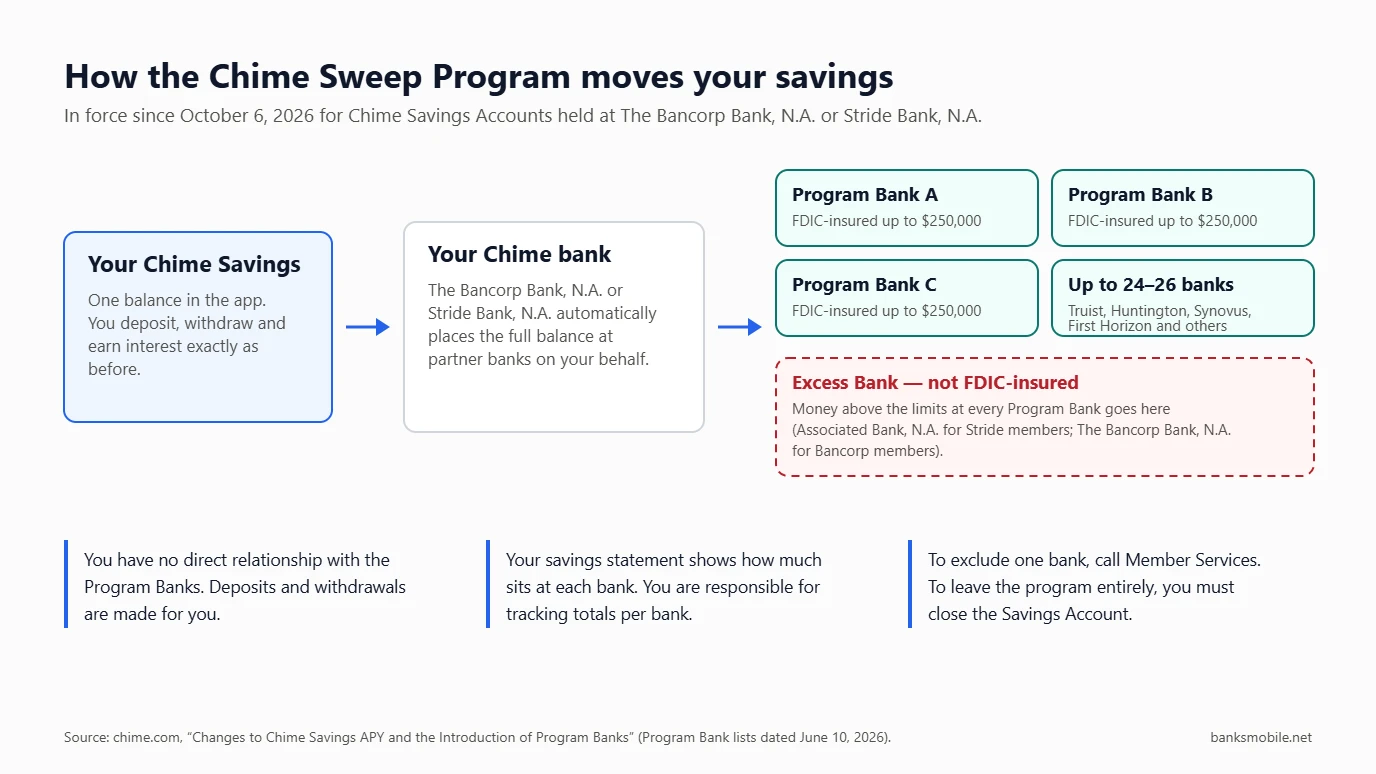
From the inside of the app nothing moves. You see one savings balance, you transfer to checking in the same taps, interest shows up in the same place. Underneath, here is how Chime Program Banks fit into the flow:
- 1.You deposit into Chime Savings exactly as before, and the money arrives at your Chime bank (Bancorp or Stride).
- 2.That bank automatically places your savings balance at one or more Program Banks on your behalf. Chime names Truist Bank, The Huntington National Bank and Synovus Bank as examples; the full Bancorp list has 24 institutions and the Stride list has 26, including First Horizon Bank, BankUnited, Amalgamated Bank, EagleBank, State Bank of India and WEX Bank.
- 3.You have no direct relationship with any Program Bank. Deposits and withdrawals are made by Bancorp or Stride for you, and Chime asks members not to contact the Program Banks directly.
- 4.Once a Program Bank has reached its coverage limit for you, additional money is placed at a designated Excess Bank: Associated Bank, N.A. for Stride members, and The Bancorp Bank, N.A. itself for Bancorp members. Funds at the Excess Bank are held “without limit and without FDIC coverage.”
- 5.Your monthly Savings Account statement shows how much sits at each Program Bank. If you want a bank excluded, you call Member Services at 844-244-6363 and your funds are moved to another Program Bank.
Why would Chime do this?
Chime has not said why, so treat what follows as my read rather than a company statement. Sweep networks are the standard way brokerages and large fintechs handle cash: spreading deposits across many banks lets a program advertise insurance well above $250,000 and keeps any single partner bank’s balance sheet from swelling. Chime’s deposit base has outgrown two mid-sized partner banks, and the company is in the middle of buying Stride Bank outright for $590 million.
On October 21, 2026, the Federal Reserve published Chime’s application to become a bank holding company, with public comments due November 20, 2026, and the deal is expected to close in the first half of 2027. A sweep program that is already running when Chime owns its own bank gives it flexibility on where deposits sit. That is my inference; the timing is a fact.
Is Chime Savings Still FDIC Insured?
Yes, with two conditions that did not exist before October 6. Chime’s own footnote is worth quoting almost in full because it is unusually direct: “Chime is not FDIC-insured. The Bancorp Bank, N.A. and Stride Bank, N.A. are the FDIC-insured members. Deposit insurance covers the failure of an insured bank. Certain conditions must be satisfied for pass-through deposit insurance coverage to apply.”
Here is what that means in practice after the change:
- ✓Each Program Bank is a separate FDIC-insured bank. Your money at each one is eligible for coverage up to at least $250,000 of principal and accrued interest per ownership category, per bank. Spread across several banks, a large balance can in theory be covered well beyond $250,000.
- ✓You, not Chime, are responsible for tracking totals. Chime’s policy page says members “are responsible for tracking their total deposits at each Program Bank” to know how much is covered. The relevant number is your combined balance at that bank, including any account you hold there directly, outside Chime.
- ✓The Excess Bank is explicitly not insured. Money that spills over after every Program Bank is full sits at the Excess Bank with no FDIC coverage. For the vast majority of members this will never be triggered, but it is now written into the terms.
- ✓Pass-through coverage depends on recordkeeping. The FDIC insures money held through a fintech only if the records show who owns what. The 2024 Synapse collapse, where tens of thousands of fintech customers lost access to funds because the ledgers did not reconcile, is the reason this clause matters. The FDIC’s proposed custodial-account recordkeeping rule, written in response, still has no final-rule date as of October 2026.
If your Chime Savings balance is under $250,000 and you do not also bank directly with Truist, Huntington, Synovus, First Horizon or another bank on the Chime Program Banks list, the sweep program changes nothing about your insurance. If either of those is not true, read your next savings statement line by line. Our guide to how neobank deposit insurance really works covers the general rules.
One more clarification, because readers ask every time Chime’s structure comes up: this applies to the Savings Account. Chime Checking, SpotMe, the Credit Builder card, early direct deposit and your routing number are unaffected by the sweep program.
How Chime’s 4.00% APY Stacks Up in October 2026
The rate increase is real, and the timing is not an accident. The Federal Reserve raised its target range to 3.75%–4.00% on September 16, 2026, its first hike since 2023, and online banks followed. One rate tracker counted 73 banks raising savings or CD rates versus 14 cutting between the September decision and October 26, with raises arriving a median of 21 days later. Chime’s October 6 move landed right in that window. The next Fed decision is due October 28, and markets priced roughly a 91–93% chance of no change, with a further hike seen as the base case for December.
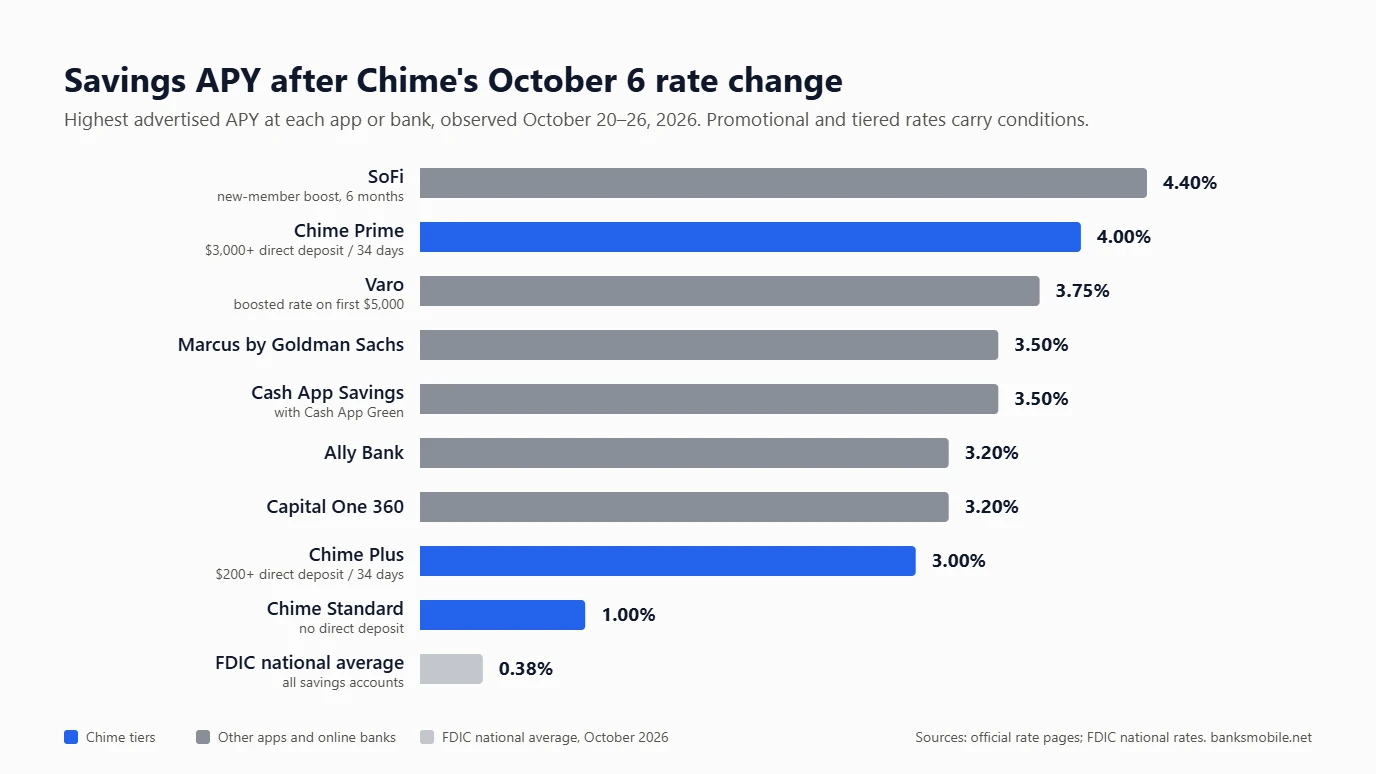
Rates observed on official pages between October 20 and 26, 2026, and the conditions attached to them:
| Account | APY | Condition |
|---|---|---|
| SoFi Savings (new members) | up to 4.40% | 3.30% base plus a 1.10% boost for six months on accounts opened from October 20, 2026, with direct deposit or $5,000 in deposits |
| Chime Prime | 4.00% | $3,000+ qualifying direct deposits in 34 days |
| Varo Savings (boosted) | 3.75% | On the first $5,000 only, with $800+ monthly direct deposit; 1.00% otherwise |
| Marcus by Goldman Sachs | 3.50% | No conditions |
| Cash App Savings | 3.50% | Requires Cash App Green ($300+ direct deposit or $500+ card spend per month); 1.50% with the Cash App Card alone |
| Ally Online Savings | 3.20% | No conditions; raised from 3.10% in late October 2026 |
| Capital One 360 Performance Savings | 3.20% | No conditions |
| Chime Plus | 3.00% | $200+ single or $400+ cumulative direct deposits in 34 days |
| Chime Standard | 1.00% | No direct deposit |
| FDIC national average, savings | 0.38% | October 2026 figure cited by Ally and Marcus |
Read the table with the conditions in mind. Chime Prime’s 4.00% is one of the highest ongoing rates among the big consumer apps, but it costs you a $3,000 monthly paycheck routed to Chime. SoFi’s 4.40% is a six-month promotion for new members. Marcus, Ally and Capital One pay less but ask nothing.
If you want the arithmetic, our explainer on what APY actually measures shows that on a $5,000 balance, the gap between 4.00% and 3.20% is about $40 a year. The direct-deposit requirement, not the rate, should drive the decision, and our Chime vs SoFi comparison goes deeper on that trade-off.
What to Do Now: A Five-Minute Checklist

- 1.Open your latest Savings Account statement in the Chime app or on the web. It now lists how much of your balance sits at each Program Bank. For most members this will be a single line.
- 2.Cross-check against banks you already use. If you hold a direct account at any bank on the Chime Program Banks list (Truist, Huntington, Synovus, First Horizon, BankUnited, Old National and others), add the two balances together. If the sum is near $250,000, call Member Services at 844-244-6363 and ask for that bank to be excluded.
- 3.Confirm your tier. Check that your qualifying direct deposits over the past 34 days put you where you expect: $3,000 or more for Prime, $200 single or $400 cumulative for Plus.
- 4.Decide whether the exit is worth it. Chime’s terms are blunt: to opt out of the sweep program you must close the Savings Account. Checking is unaffected, so you can keep Chime for spending and hold savings elsewhere if the structure bothers you.
- 5.Keep an eye on the Stride acquisition. Once Chime owns Stride Bank, the Program Bank lists and the Excess Bank could be updated. If Chime changes the lists, we will update this page.
Who Should Care About Chime Program Banks, and Who Can Ignore Them
- •Typical member with under $250,000 in savings and no account at a Program Bank: nothing changes except a higher rate. Your coverage is the same as it was, now spread over more banks.
- •Members with large balances: the program can raise your effective coverage above $250,000 because each Program Bank insures you separately, but only if you check the statement and keep track.
- •Members who also bank with a Program Bank directly: this is the one group with a real, if small, new risk of exceeding a limit at a single bank without realizing it.
- •Anyone uncomfortable with money held through a fintech after Synapse: the sweep program adds layers, but it also adds per-bank statements. Our piece on what happens if a neobank shuts down explains what would and would not happen to your money.
Frequently Asked Questions
What is a Chime Program Bank?
Chime Program Banks are the FDIC-insured U.S. banks, such as Truist, Huntington or Synovus, where The Bancorp Bank, N.A. or Stride Bank, N.A. automatically places your Chime Savings balance under the Chime Sweep Program that took effect on October 6, 2026. You have no direct relationship with the Program Bank; your Chime bank makes deposits and withdrawals on your behalf.
Is Chime Savings FDIC insured after the Program Banks change?
Yes. Money placed at each Program Bank is eligible for FDIC pass-through coverage up to at least $250,000 per depositor, per ownership category, at each bank. The exception is the Excess Bank, which holds anything above those limits without FDIC coverage. Chime says members are responsible for tracking their own totals at each Program Bank.
Can I opt out of the Chime sweep program?
You can ask Member Services (844-244-6363) to exclude a specific Program Bank, and your funds will be moved to another one. To leave the program entirely, Chime’s terms require you to close your Savings Account. Chime Checking is not part of the sweep program.
Did Chime raise its savings APY in 2026?
Yes. Effective October 6, 2026, Chime Savings pays 4.00% APY for Chime Prime, 3.00% for Chime Plus and 1.00% for Standard members, up from 3.75%, 2.75% and 0.75% when the tiers launched on April 2, 2026. The rates are variable and can change at the bank’s discretion.
How do I get Chime’s 4.00% APY?
You need Chime Prime status, which requires $3,000 or more in qualifying direct deposits to your Chime Checking Account within the past 34 days. Chime Plus, at 3.00%, requires a single $200+ direct deposit or $400+ cumulative in the same window. Without direct deposit you earn the 1.00% Standard rate.
Will the Stride Bank acquisition change the Program Banks?
It could. Chime applied to the Federal Reserve to become a bank holding company by acquiring Stride Bank; the application was published on October 21, 2026, with comments due November 20, and the deal is expected to close in the first half of 2027. Chime has not announced any change to the Program Bank lists, which are dated June 10, 2026.
The Bottom Line on Chime Program Banks
Chime’s October 6 update is a fair trade for most members: a quarter-point raise on every tier in exchange for a deposit structure that is standard across the industry but asks you to read your statement once in a while. The 4.00% Prime rate is competitive only if you were going to route a $3,000 paycheck to Chime anyway, and the FDIC picture is unchanged for anyone under $250,000 who does not already bank with a Program Bank.
If you are weighing whether Chime is still the right home for your savings, start with our full Chime review, then compare the live rates in our high-yield savings rate guide. Both are updated as banks move after the October 28 Fed decision.
- Chime: Changes to Chime Savings APY and the Introduction of Program Banks (effective Oct 6, 2026)
- Chime Savings Account page (rates effective 10/06/2026)
- Chime Newsroom: launch of Chime Prime (Apr 2, 2026)
- Federal Register: Chime Financial, Inc. bank holding company application (Oct 21, 2026)
- Chime Investor Relations: agreement to acquire Stride Bank (Sept 8, 2026)
- Federal Reserve: FOMC statement, Sept 16, 2026
- Raisin: pre-FOMC preview, Oct 23, 2026
- YourBestSavings Fed decision rate tracker (Oct 26, 2026)
- SoFi Checking and Savings rates
- Varo Bank savings rates
- Marcus by Goldman Sachs Online Savings
- Ally Bank Online Savings Account
- Cash App: savings interest rate