An instant bank transfer moves money in seconds, 24 hours a day, on a real time rail like FedNow or RTP. More than 1,800 US banks and credit unions are now live on FedNow, but that is still a minority of the roughly 9,000 institutions in the country. If your transfer is slow, your bank almost certainly sent it over the old ACH batch system instead.
You send money at 9 p.m. on a Friday. Your friend gets nothing. The app says it will arrive Tuesday. Meanwhile a different transfer you made last week landed before you could put your phone back in your pocket.
Same amount, same phone, wildly different experience. The reason has almost nothing to do with your bank being lazy and everything to do with which set of rails your money was placed on.
In 2026 the United States finally has real instant payment infrastructure. The Federal Reserve FedNow Service passed its three year mark in July with more than 1,800 financial institutions connected, and the private RTP network has been running since 2017. The catch is that adoption is uneven, so millions of people still live with transfers that crawl.
This guide explains, in plain English, why an instant bank transfer works sometimes and not others, how to find out which rail your bank uses, and what you can do today to make your money move in seconds.
- ✓ A true instant bank transfer settles in seconds on FedNow or RTP, any hour, any day, including weekends and holidays.
- ✓ More than 1,800 institutions are live on FedNow after three years, out of roughly 9,000 US banks and credit unions, which is why speed still depends on who you bank with.
- ✓ Zelle feels instant because your bank fronts the money, but behind the scenes it often settles on the older ACH system, which is why some payments get held or reversed.
- ✓ Instant is final. Real time payments are difficult or impossible to claw back, so a scam sent instantly is usually money gone.
- Why your bank transfer is still slow in 2026
- The four rails behind every instant bank transfer
- Is your bank on the instant network?
- How to send an instant bank transfer today
- Who gains the most from an instant bank transfer
- What an instant bank transfer really costs
- The catch: instant money is irreversible
- The bottom line
- Frequently Asked Questions
Why Your Bank Transfer Is Still Slow in 2026

For fifty years, almost every ordinary US payment traveled on the Automated Clearing House, better known as ACH. ACH does not move money continuously. It gathers payments into batches, processes them at set windows during business days, and skips nights, weekends and federal holidays entirely.
That design is why a Friday evening transfer can sit until Tuesday. Nothing is broken. Your money is simply waiting for the next batch, and Monday might be a holiday.
The fix arrived in two waves. The Clearing House, owned by a group of large banks, launched the RTP network in 2017. The Federal Reserve followed with the FedNow Service in July 2023, aimed squarely at giving smaller community banks and credit unions the same capability. Both settle payments in seconds and run every hour of every day.
Adoption is the bottleneck. FedNow started with 35 institutions, reached about 900 after one year, roughly 1,400 after two, and passed 1,800 at its three year mark in July 2026. Impressive growth, but the country has around 9,000 banks and credit unions. Even some of the largest names have not fully joined. If your institution is in the majority that has not connected, your transfer still rides the batch system.
The Four Rails Behind Every Instant Bank Transfer
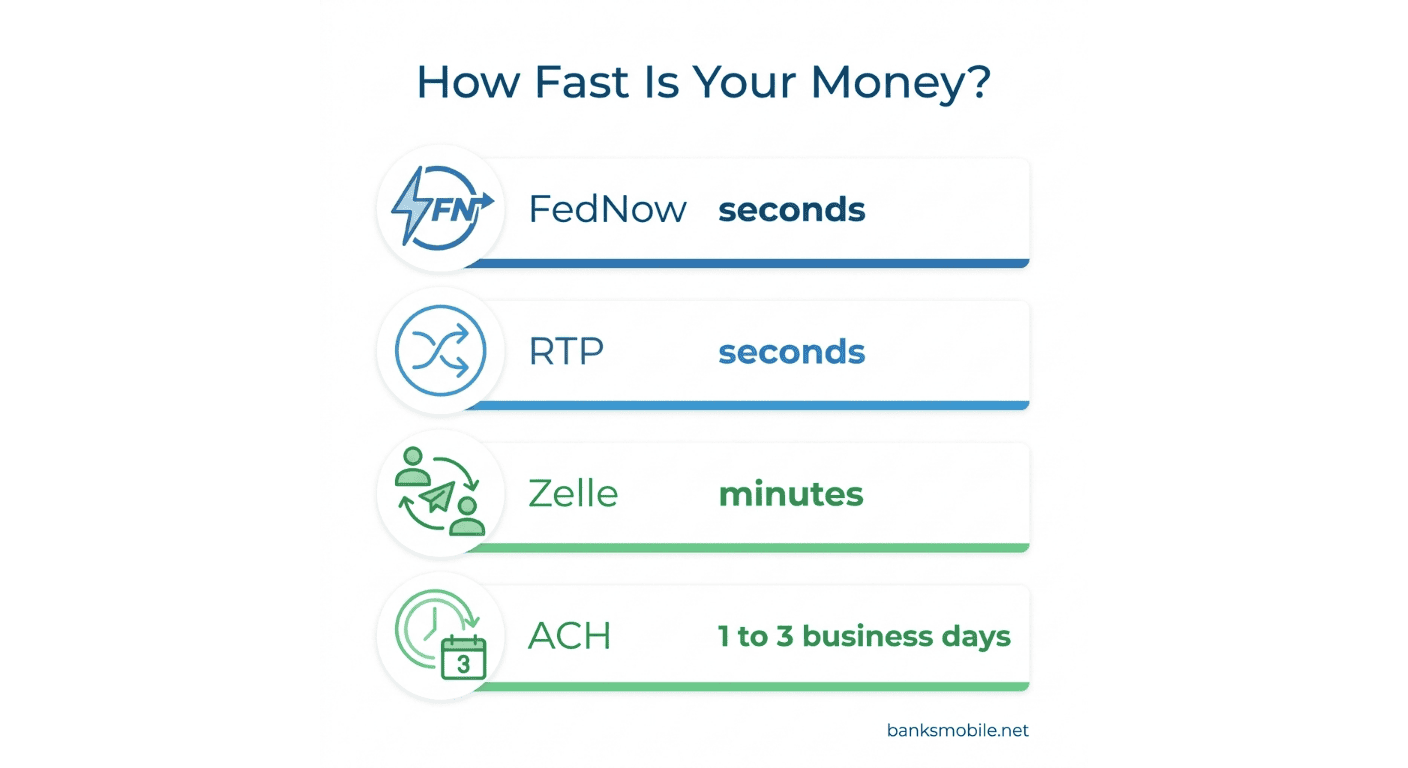
When an app promises instant money, it is using one of four systems. Knowing which one explains the speed, the fee and the risk.
| Rail | Who runs it | Real speed | Typical consumer cost |
|---|---|---|---|
| FedNow | Federal Reserve | Seconds, 24/7/365 | Usually free to receive, often free to send |
| RTP | The Clearing House | Seconds, 24/7/365 | Usually free to receive |
| Zelle | Early Warning Services | Feels instant, settles behind the scenes | Free at most banks |
| Push to card | Visa and Mastercard | Minutes | Around 1.5% to 1.75% of the amount |
That last row is the one that quietly costs people money. When Cash App, Venmo or PayPal offers to move your balance to your debit card immediately for a small percentage, it is usually pushing funds to your card rather than using a bank rail. It is fast, but you are paying for speed you might get free elsewhere. Our guides on the best P2P payment apps and moving money from Cash App to Venmo break down where those fees appear.
Zelle deserves its own note. Your bank typically credits the recipient right away, then settles the actual funds afterward, sometimes over ACH and sometimes over RTP when both banks support it. That gap between what you see and what has actually settled is exactly why payments occasionally stall or bounce back. If that has happened to you, our breakdown of why a Zelle transfer fails walks through every cause, and Venmo versus Zelle compares how each handles timing.
Is Your Bank on the Instant Payment Network?
You can find out in about two minutes, and the answer decides everything about your transfer speed.
The Federal Reserve publishes a public list of every institution live on FedNow, searchable by name, on its official participants page. Look for your bank, and check whether it is listed as a receiving participant, a sending participant, or both. Many institutions switch on receiving first, which is why money sometimes arrives instantly but will not leave instantly.
Two patterns are worth knowing. Community banks and credit unions have been unusually quick to adopt, because instant payments let them compete with far larger rivals. Meanwhile several giant banks have moved slowly, partly because they already own the RTP network and Zelle. Bigger does not mean faster here.
Digital banks are their own case. Many run on a partner bank, so the rail depends on that partner rather than the app you see. If you are unsure who actually holds your money, start with which bank Chime uses, then read how safe neobanks really are and what happens if one shuts down.
How to Send an Instant Bank Transfer Today
Check both sides. An instant bank transfer needs the sending bank and the receiving bank on the same real time rail. One participant is not enough.
Look for the wording in your app. Banks rarely say FedNow. They say instant transfer, real time payment or send now, usually next to a slower free option.
Use Zelle for everyday person to person payments if both banks support it, since it is free at most institutions and settles fast between major banks.
Skip the wire for domestic payments. A wire transfer is same day but often costs $15 to $30, which makes little sense when a real time rail does the job for free.
If your bank is stuck in the slow lane, change the timing instead of the rail. Early direct deposit effectively buys you two days, and it is free at many digital banks.
Who Gains the Most From an Instant Bank Transfer
Not everyone feels the difference equally. For some households an instant bank transfer is a convenience. For others it is the difference between a covered bill and an overdraft fee.
People paid on variable schedules feel it first. Gig workers, hourly staff and freelancers often need money the moment a job ends, not two business days later. Instant payouts let them cover fuel, groceries or a bill the same evening, which is why an instant bank transfer has quietly become a recruiting argument for delivery and rideshare platforms.
Renters and bill payers are the second group. When a due date lands on a Monday holiday, an ACH payment started Friday can post late and trigger a fee that dwarfs the amount at stake. A real time rail removes that calendar risk entirely.
Small businesses gain the most in cash flow terms. Getting paid in seconds rather than days shortens the gap between doing the work and being able to spend the money, and it removes the guesswork from payroll week. Surveys of US businesses have found that most would use instant payments if their bank offered them, and that those already using them report higher satisfaction with their bank.
If none of those describe you, an instant bank transfer is still worth understanding for one reason: it tells you whether your bank is investing in modern infrastructure or coasting on the old system.
What an Instant Bank Transfer Really Costs

Here is the part the industry does not advertise. The wholesale cost of sending a payment over FedNow or RTP is a fraction of a cent for the bank. Receiving one costs even less. There is no economic reason for a bank to charge you several dollars to move money in seconds.
In practice, most consumer banks charge nothing to receive and nothing or very little to send. Where costs appear is at the app layer, in that 1.5% to 1.75% instant cashout fee. On a $500 balance that is up to about $8.75 to skip a wait that a real time rail would eliminate for free.
The practical lesson is simple. Before paying for speed, check whether the free path is already instant between your two banks. If you are choosing where to keep your cash, that speed is worth weighing alongside the yield, which our guides on 2026 savings rates and high yield savings accounts cover in detail.
The Catch: Instant Money Is Irreversible
Speed cuts both ways. The delay in the old system was accidental protection. Money sitting in a batch could sometimes be stopped. On a real time rail, settlement is final in seconds, and there is no pause button.
Treat an instant bank transfer like handing over cash. Confirm the recipient through a channel you chose yourself, never one from the message asking for money, and never send instantly to someone you have not met. Our guides on Venmo safety and Cash App scams cover the tactics that show up most.
Regulators and banks know this, which is why the Fed has been adding fraud tools to FedNow, including customizable value and velocity limits that let an institution cap unusual activity. Those controls sit at the bank level though. Your own habits remain the real defense. The Consumer Financial Protection Bureau keeps free, plain English guidance on payment scams at consumerfinance.gov.
One more thing worth watching: if a payment will not go through at all, that is often an account or linking problem rather than a rail problem. Our fixes for Cash App refusing to link a bank account and using Zelle with Chime handle the most common cases.
The Bottom Line on an Instant Bank Transfer in 2026
The infrastructure question is settled. The United States has real instant payment rails, they work every day of the year, and they cost banks almost nothing to run. Whether you personally get an instant bank transfer now comes down to one thing: whether your bank bothered to connect.
So check the Federal Reserve participant list for your institution and the one you send to most. If both are live, use the free instant option and stop paying cashout fees. If yours is missing, that is a genuine reason to consider moving, and plenty of online banks and app based accounts already treat instant as standard.
Waiting until Tuesday for your own money is no longer a technical limitation. It is a choice your bank made for you, and in 2026 you can make a different one.
Frequently Asked Questions
What is an instant bank transfer?
An instant bank transfer is a payment that settles in seconds on a real time rail such as FedNow or RTP, available 24 hours a day including weekends and holidays. Unlike an ACH transfer, the money is available immediately and the payment is final.
Why is my bank transfer taking so long?
Most likely your bank sent it over ACH, which processes in batches on business days only. A transfer started on a Friday evening or before a holiday waits for the next processing window. Your bank may also not be connected to any instant payment network.
How do I know if my bank uses FedNow?
The Federal Reserve publishes a searchable list of every participating institution on its official FedNow participants page. Check whether your bank is listed for sending, receiving, or both, since many enable receiving first.
Is an instant bank transfer free?
Receiving is almost always free, and many banks do not charge to send either, because the underlying cost to them is a fraction of a cent. The fees you notice usually come from payment apps charging roughly 1.5% to 1.75% to push a balance to your debit card instantly.
Can an instant payment be reversed?
Generally no. Real time payments settle with finality in seconds, so there is no window to stop them. That is why you should only send instantly to people and businesses you have verified independently.
Is Zelle the same as an instant bank transfer?
Not exactly. Zelle usually gives the recipient immediate access to the funds, but the actual settlement between banks may happen later over ACH, or over RTP when both banks support it. It feels instant, though the money movement underneath is not always a real time payment.